
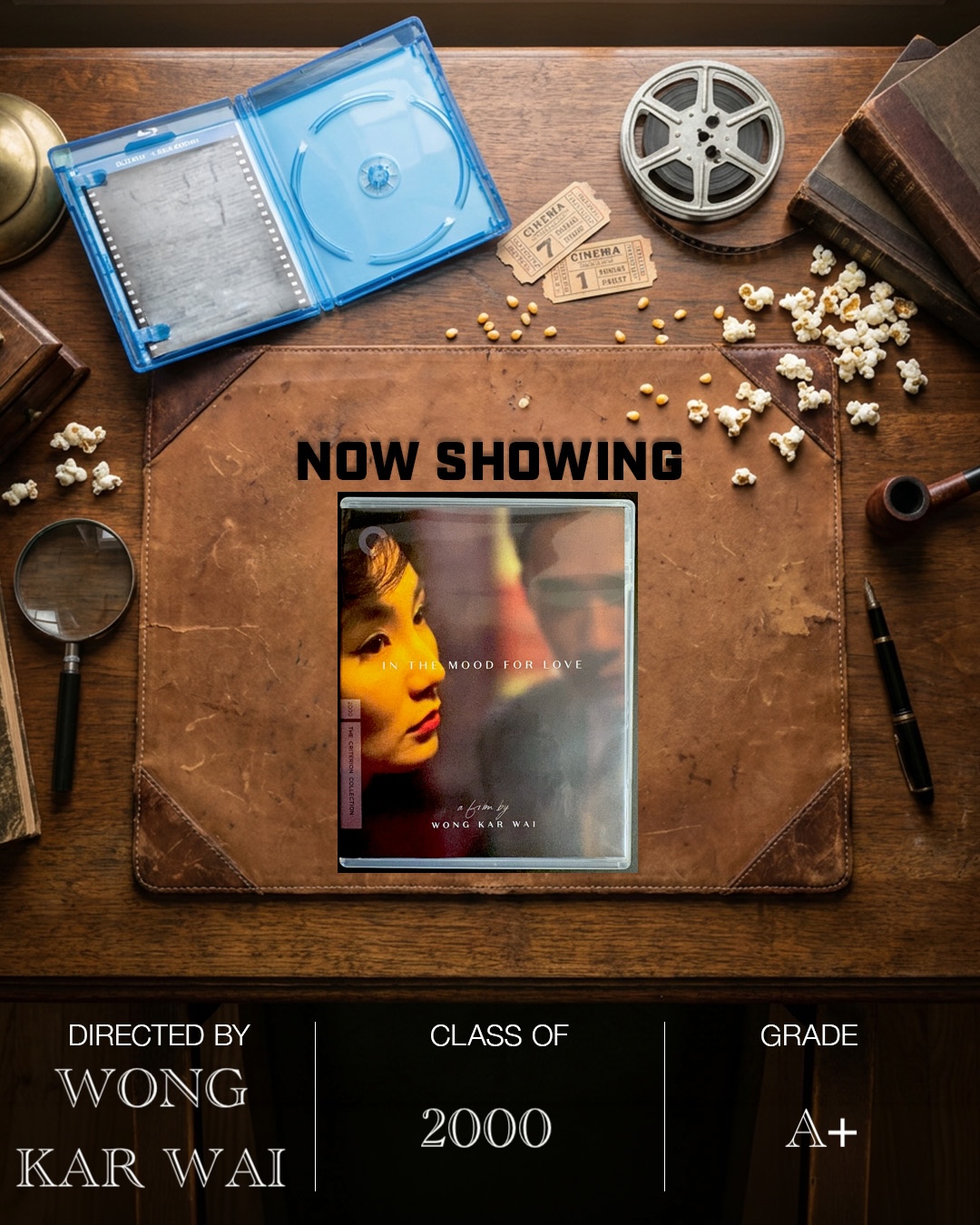
Feel the heat, keep the feeling burning, let the sensation explode. Two neighbors form a strong bond after both suspect extramarital activities of their spouses. However, they agree to keep their bond platonic so as not to commit similar wrongs.
Written by Dean Zarbaugh II
Sorry that I haven’t been posting as much on here lately. I started a new job right before launching this site and I’ve been adjusting to the new schedule while also finding the time to sit down and write about the movies that I’ve been watching. I am going to try to be more consistent on the site moving forward. Yes, I know what Yoda would say if he heard that, and no, I won’t amend it. First up on the new consistency train is In the Mood For Love.
Like I mentioned in my review of Three Colors: Blue, it was my first ever Kieslowski film. Similarly, In the Mood For Love marks my late stage introduction to the illustrious work of Wong Kar Wai, and holy shit, I’ve been missing out! I had been meaning to get around to watching his films, but something else would always end up distracting me. Curse you, ADHD! When I finally sat down to watch In the Mood For Love at the urging of my friend Cameron, I was gobsmacked at the beauty Wong Kar Wai and the cast and crew brought to the film and the story. I absolutely love films like this that are a quiet, thoughtful, reflective character exploration driven by intimate performances by supremely talented actors, and top tier writing, directing and cinematography. It isn’t flashy. It doesn’t have any thrilling “edge of your seat” sequences. It doesn’t feature visual effects work. It’s simply top notch storytelling in its purest form.
In the Mood For Love plays out like an intricately choreographed dance, gracefully swaying between two jilted spouses as they come to terms with each of their significant other’s infidelities. Wong Kar Wai masterfully directs the film which glides through its runtime thanks to beautiful cinematography and powerful performances from the lead actors Maggie Cheung Man Yuk and Tony Chiu Wai Leung. At the center of the film are Su Chan and Chow Mo-wan, the aforementioned spouses who suspect that their significant others are carrying on an affair with each other behind their backs. They seek solace in each other, but what follows isn’t a sultry, physical affair, but one told through stolen glances and brush ups passing one another in the halls. It’s one of the best portrayals of that yearning, unspoken love that I’ve seen on film. They could easily go down the same road as their spouses and act on their impulses, however, that would lower themselves to their spouses’ level, but in ignoring their feelings, they risk losing out on a chance to actually be happy in a relationship with someone who respects them as a person. I’d go as far to say that it might be the best romance movie behind Casablanca, in my humble opinion, and I hold Casablanca in extremely high regard as my favorite movie of all time.
With Wong Kar Wai and cinematographer Christopher Doyle utilizing the “frame within a frame” cinematography, they give the film a voyeuristic feeling with many shots taking place from doorways, windows, or another room completely. This effect makes the audience feel like they’re there in the room with the characters. It also works as a visual metaphor for how isolated and trapped both of them feel in their relationships and lives in general. They are surrounded by a tight nit group of neighbors, who have eyes and ears everywhere and are quick to gossip about they see and hear, forcing them to keep things quiet between them. It’s a beautiful looking film that takes “aura farming” to a whole new level with Tony Chiu smoking cigarettes under neon signs. Wong Kar Wai and production designer William Chang’s use of muted colors throughout the set pieces visually mimics the isolating, emotional prison the characters find themselves living in.
The story, which is also written by Wong Kar Wai, unfolds not through fast paced dialogue the likes of which scribes like Aaron Sorkin are known for, but through meditative study of real-to-life characters. It says more in its silences than most modern movies say throughout their entire story. In the Mood For Love instantly captivates you and makes you root for Mrs. Chan and Chow Mo-wan to end up together. Their journey throughout the film speaks deeply to desire, morality, restraint, judgement, trust and happiness. In their quest to understand where their relationships went off the rails, they get together to “re-enact” how their spouses could have met and struck up their affair, or to practice what they will tell their spouse when they break up with them. This helps both Chow and Su process their feelings and come to terms with their situation. What’s heartbreaking is watching them discover how painful the ordeal actually is, bond over their shared trauma, yet continue to keep each other at arm’s length in fear for societal repercussions. It’s a beautiful story that stands the test of time.
Maggie Cheung Man Yuk is magnetic as Su Chan. She captivates as a woman dealing with her husband’s infidelity. She effortlessly glides through her scenes, conveying more with a single look than most actors could if they were given 1,000 words. She is able to command scenes with her mere presence, and turns in one of the strongest performances on film in the last 30 years. She is downright sensational throughout the film, and makes you want to watch more of her work (which I plan on doing.)
Tony Chiu Wai Leung is equally captivating as Chow Mo-wan. He knows he can’t act on his feelings for Su, but that doesn’t stop him from having those feelings. Leung has terrific chemistry with Maggie Cheung Man Yuk which the entire film rests on. You can feel his longing for her through the screen. It’s a fantastic performance that stands strong opposite a powerful performance by Maggie Cheung Man Yuk. A lesser actor would be eclipsed by a standout performance like hers, but Tony Chiu Wai Leung rises to the occasion and shines brightly beside her.
Mrs. Chan’s wardrobe is its own character in the film. Discussions on best wardrobe in a movie tend to skew more towards Givenchy’s work with Audrey Hepburn, Edith Head’s collaboration with Grace Kelly in Rear Window, or Anthony Sinclair’s stylish designs for Sean Connery’s outings as 007, and not enough attention is paid to William Chang’s work on In the Mood For Love. Mrs. Chan looks amazing throughout the film, her wardrobe a reflection of her character. Classy, proper, and tidy. Her dresses are the one wonderfully fresh variable in the monotonous, drab, and unchanging routine that Su and Chow find themselves stuck in.
Much like Kieslowski’s Blue and Werner Herzog’s Aguirre, the Wrath of God before it, I immediately rewatched In the Mood For Love after finishing my first viewing. It’s a beautiful and unique piece of filmmaking that dives into the deep end of human emotions and begs to be watched again as soon as possible. If you’re unfamiliar with the work of Wong Kar Wai, I highly suggest In the Mood For Love as an entry point for you. You will not be disappointed.
GRADE: A+



Leave a Reply