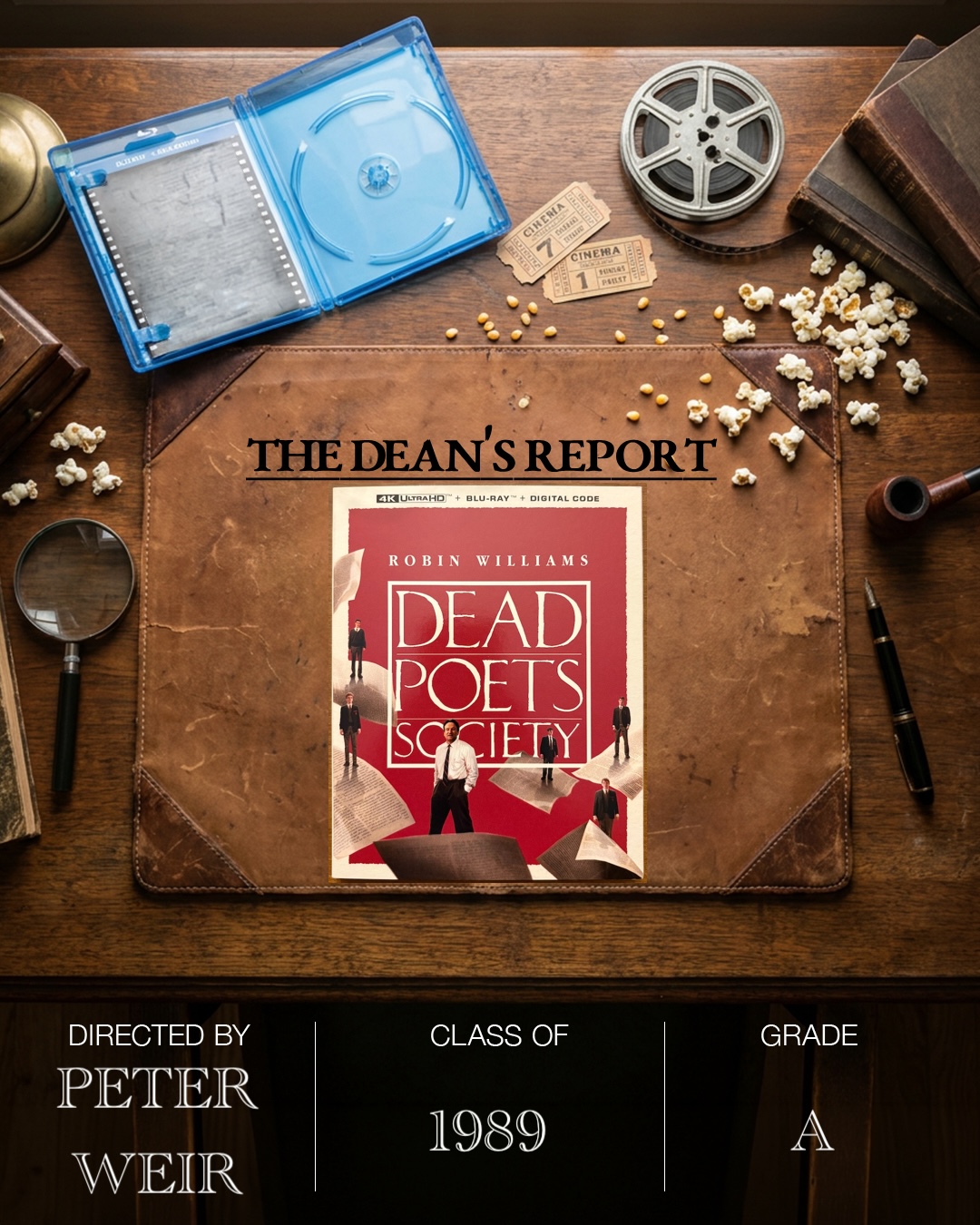
He was their inspiration. He made their lives extraordinary. At an elite, old-fashioned boarding school in New England, a passionate English teacher inspires his students to rebel against convention and seize the potential of every day, courting the disdain of the stern headmaster.

Written by Dean Zarbaugh II
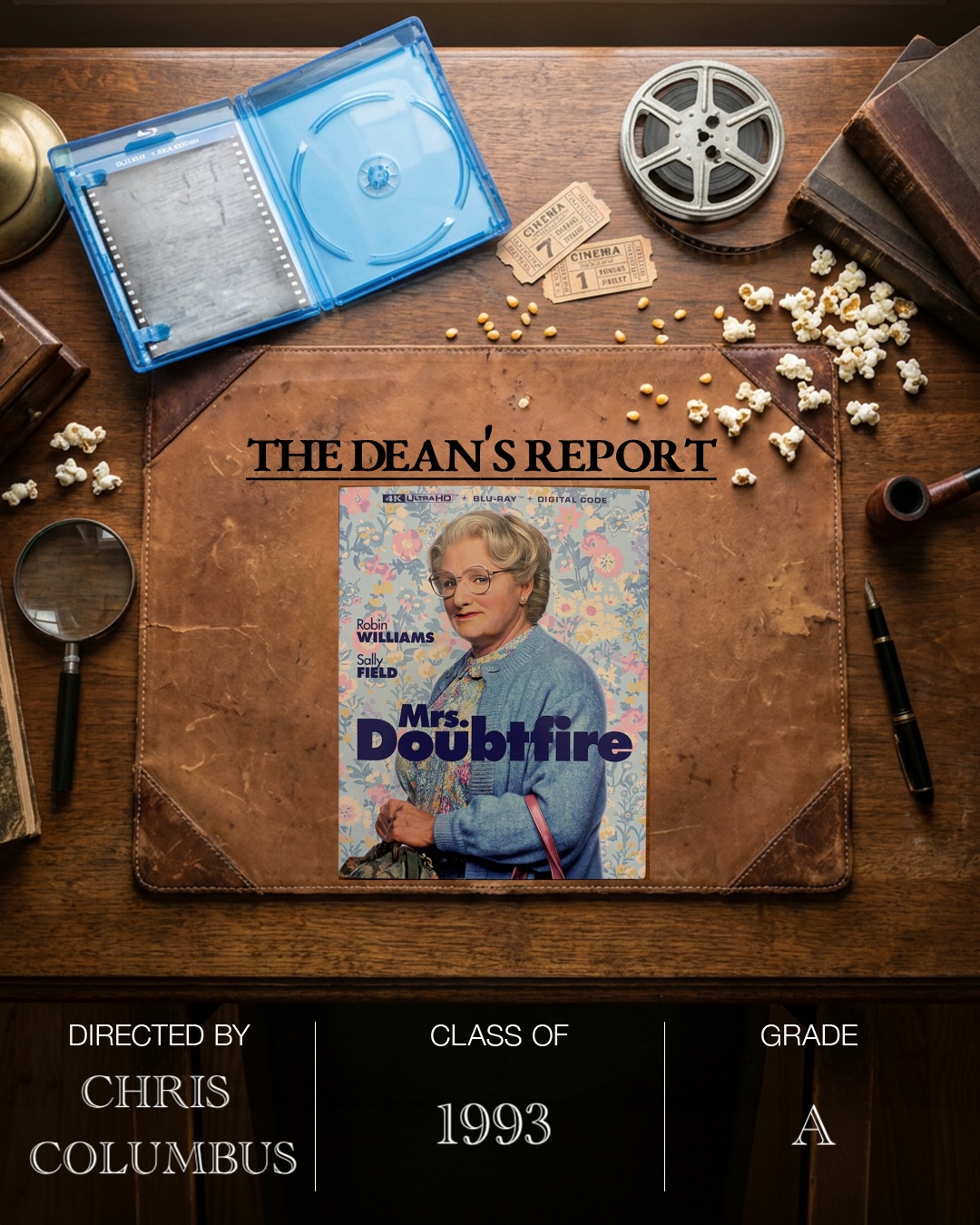
Robin Williams fans were recently treated to new 4K upgrades to two of his most renowned work: Mrs. Doubtfire (which I’ve already written about here) and Dead Poets Society, the film that many of us had to endure watching during high school English class. It’s a much different experience watching a film in 45 minute chunks with certain bits being fast forwarded or skipped altogether as well to keep us from seeing or hearing “sensitive content.” I’m happy to report that both films look incredible in 4K and are worthy upgrades for your collection. I miss Robin Williams a lot, and I’m glad I can pop in one of his movies whenever I feel like remembering a titan of entertainment.
I was excited to revisit this film now that I’m 40, and don’t have the immature kids giggling at certain parts throughout. I was curious as to how Dead Poets Society would affect me all these years later with a couple decades of life experience under me. I was surprised at how many emotional beats I didn’t fully understand or appreciate when viewed in high school.
Writer Tom Schulman deservedly won an Academy Award for his screenplay for the film. He based the story upon his own experiences at Montgomery Bell Academy, and the teachers who inspired him. The story sends our characters through dizzying heights and cavernous lows as they make their way through another year at the prestigious Welton Academy. Neil Parry wants nothing more than to be able to decide his own life and his own future, but his rigid, militaristic father will have none of it. I know what it’s like to not live up to a father’s expectations for his son. My dad wanted nothing more than for me to be a veterinarian in order to set myself up in a solid career that provides a great quality of living, and has the added benefit of patients not arguing with you about every decision. I know it hurt him to watch me go into the entertainment industry, and to be honest, looking back at that decision twenty odd years later, he was right for wanting more from me. My career in this dreadful industry hasn’t exactly gone to plan, and while some of that is indeed my fault, not all of it is, but that doesn’t change the outcome any less. If I could go back and do it all over again, I’d probably take things more seriously with my studies and pursue a different career path. Schulman taps directly into that dynamic and makes the audience sympathize with Neil’s plight. All of the different students are clearly defined, and each have their own quirks and hobbies that make them unique. It is a coming of age story that is tightly crafted from beginning to end and makes you feel like you’re a part of the Dead Poets Society yourself. It’s a powerful, emotional, heartfelt, inspirational, and at times humorous look into the high pressure lives of kids not just at the most elite high schools, but every single high school in the nation. We put so much pressure and drama on children at a time when they are highly emotional, and still learning life’s ropes, it’s no wonder that many of them feel like it’s too much to handle. It is too much for someone that age to handle, and yet we keep setting lofty goals for them and getting mad at them when they don’t meet expectations. How about we just let people figure out who they are for themselves? Does that sound good? Good. It takes a master craftsman to weave that many emotions into a ~120 page script, and Schulman flaunts his skills here.
John Seale’s gorgeous cinematography and various shots of all of the vibrant fall foliage makes Dead Poets Society a film that I always associate with fall. His talent behind the camera is on full display in Dead Poets, giving the film a visual weight to go along with the heavy themes of the story. Every shot visually conveys what would take hundreds of words to present in terms of characters and their relationships with one another as well as Neil’s rivalry with his father. We are given an added layer of tension on top of the incredible work from the script’s writer Tom Schulman that brings these dynamics to life.
What I love most about the film is how subdued Robin Williams is in the role of Mr. Keating. There are glimpses of the mania that he was famous for, but even those moments seem more grounded than ever when performed here. He was magnificent at radiating emotions from his eyes. In them you can see happiness, joy, trepidation, hope, fear and loss. Williams trained at Juilliard and while he was primarily known for his lightning quick wit, he was able to draw on that training at the drop of a hat and give one of the nuanced performances of his career. He did it again in One Hour Photo, playing against type with maximum effect. He was one of very few actors who could quite literally do anything.
Robert Sean Leonard would go on to become known as Dr. Wilson on Fox’s hit show House, M.D. playing opposite a marvelous Hugh Laurie. But here, before House is even a glint in his eye, Leonard gives one of the most real, raw and honest performances in film. He is a tremendously gifted actor, and makes you instantly sympathize with him and his home life because Leonard brings a level of emotion and detail to the role that few actors could have mustered. We want Neil to win. We want him to succeed in his play, find himself and crawl out from under his father’s shadow. We understand his drive and his passion because we’ve all been there in some form or another in our lives. We’ve pushed for goals that others deemed silly or dumb, but were important for us to find out who we are as a person. Leonard tapped into that in this performance and it’s a travesty that it wasn’t given more awards attention.
Neil’s iron fisted father is played pitch perfectly by legendary actor Kurtwood Smith, who himself would go on to star on another smash Fox hit: That 70’s Show playing a much more humorous and understanding version of his character in Dead Poets Society. The way he carries himself here, the tone of his voice, his cadence, everything is spot on for a character we are meant to dislike, and dislike him we do. From his very introduction, we get a crystal clear picture of who he is, and what a buzzkill he is going to be for these kids.
Dead Poets Society may be one of those movies that you associate negatively with high school, and I understand that, but it is definitely worth revisiting as an adult with more life experience behind you and a better understanding of how the world works. It’s an emotional story that is filled with incredible performances and makes you think in a way only the best movies can. It’s an honest look at the pressure and stigma that comes along with higher learning and how other people’s expectations of us changes how we perceive ourselves.
FINAL MARKS: A



Leave a Reply