
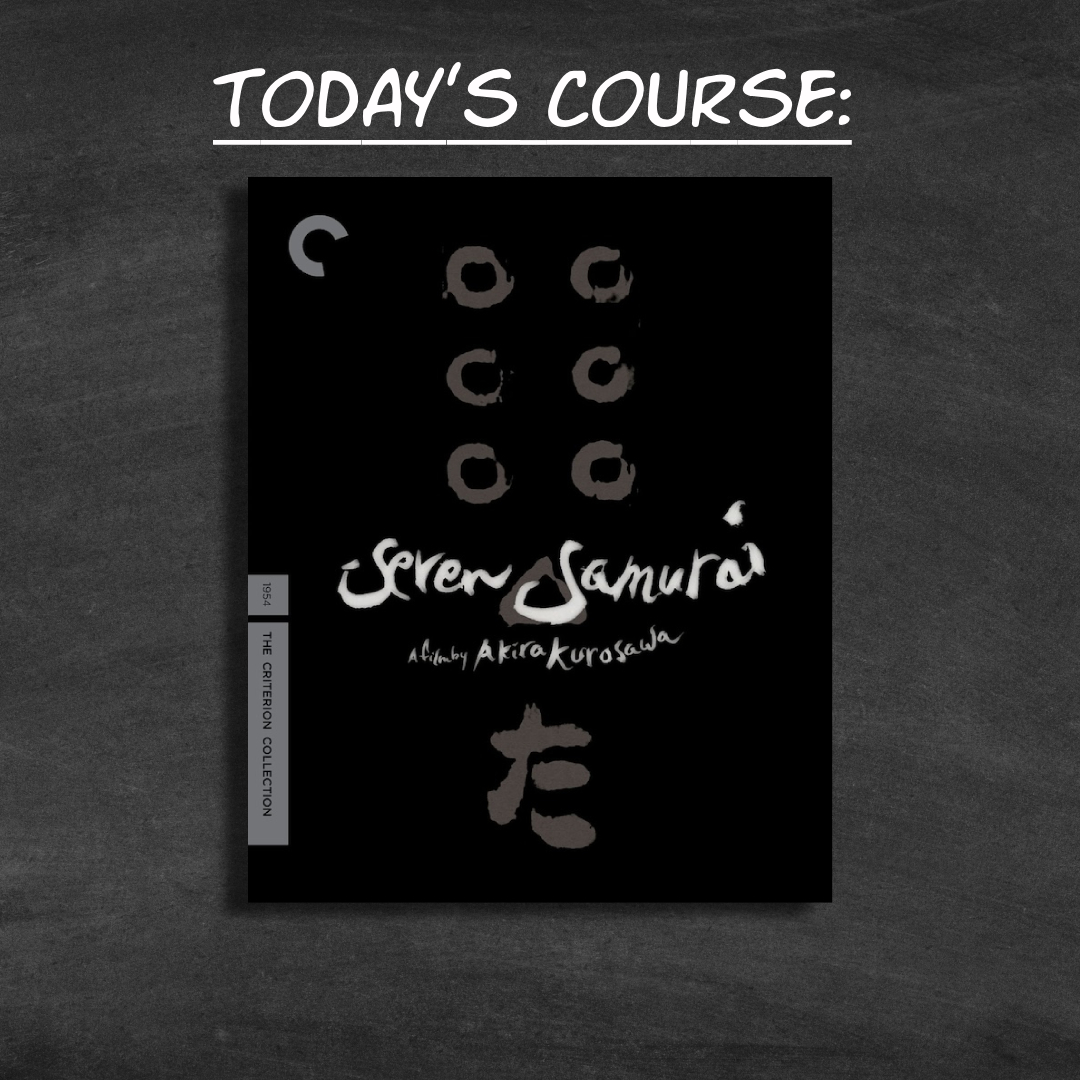
Unmatched for suspense and spectacle! A samurai answers a village’s request for protection after he falls on hard times. The town needs protection from bandits, so the samurai gathers six others to help him teach the people how to defend themselves, and the villagers provide the soldiers with food.

Written by Dean R. Zarbaugh II
Good afternoon, class. Today we will be discussing Seven Samurai and its depiction of honor and morality during times of desperation and violence.
Introduction
I’ve written about my love and appreciation for filmmaker Akira Kurosawa in the past in my writings on Rashomon and more. It’s impossible to put into words the effect his filmography has had on my own writing and visual styles.
So imagine my elation when I saw a post from my local independent movie theater that said they would be showing one of my favorite movies of all time on the big screen: Seven Samurai. As a huge Kurosawa disciple, and Samurai is my favorite of his works. I rushed to click the link to buy my ticket and I was grinning ear to ear the entire drive there. With a nearly 3.5 hour runtime, I refrained from drinking any liquids to allow myself to enjoy the film in comfort.
I was excited to see the large turnout for the film, and even more excited that a large portion of that audience skewed towards younger college aged kids who spoke outside before the film about their lack of familiarity with the film and Kurosawa’s filmography in general. During intermission, I happily gave them some suggestions for more Kurosawa films that they should check out including Stray Dog, Ikiru, and High & Low as they feature Toshiro Mifune and Takashi Shimura, two actors that I heard them highlight as their favorites in Seven Samurai. As they say, the kids are going to be alright.
Directing/Cinematography
While Seven Samurai is my ultimate Kurosawa movie, I wouldn’t say that is his best-looking. For that, I would suggest Ran and Dreams for their use of vibrant colors and dreamscapes, but that’s not to say Samurai is ugly by any means. Seven Samurai‘s moody and atmospheric aesthetic matches the flawed, morally ambiguous characters that inhabit the film, from the samurai themselves to the “innocent” farmers that they swear to protect.
Alongside cinematographer Asakazu Nakai, Kurosawa expertly paints with light and shadows in every shot. The titular seven samurai aren’t the perfect heroes in shining armor that swoop in to save the day. They are worn, weathered, tortured souls that have been on the losing side more often than not throughout their lives.
With the epic scale of the battles and the destruction that comes with them, Kurosawa and Nakai were among the first to utilize multi camera setups to capture the action simultaneously to reduce the need for multiple takes which would also reduce any continuity errors that could crop up. They also set the cameras further from the action and used telephoto lenses to allow the battles to rage without interruption from the camera and audio gear. This also compressed the space within the frame, emphasizing the scale of threat and dominance of the invading bandits. This technique also brings the audience up close and personal with the action giving them an intimate sense of the scale, weight, and destruction of war.
As with many Kurosawa movies, he expertly uses the weather to help convey mood or tension. It never rains normally in a Kurosawa movie, it comes down in sheets, drenching the actors, locations and everything on screen. It adds to the suspense and weight of the battles.
In order to reduce confusion among audiences with such a large cast and kinetic camera movements, Kurosawa developed a visual language to Seven Samurai in which protagonists often move left-to-right and antagonists move right-to-left. This allows the action to still be decipherable among the chaos of the battles.
Editing
Kurosawa worked closely with editor Koichi Iwashita to cut seamlessly on either character or camera movements, rendering the edits nearly imperceptible to the audience during the massive battle sequences and gives the film its distinct rhythm and pacing. Iwashita uses many wipe transitions to visually convey a jump in time or location. Between Kurosawa’s shot selection and Iwashita’s editing, they are able to emphasize the ultimate consequence of violence through highlighting a bandit’s reaction or fatal fall, giving weight to every death.
Script
Kurosawa and co-writers Shinobu Hashimoto and Hideo Oguni explore a lot of themes in this meditation on war and violence including social structure, honor, dignity, pride, morality, and more.
What I love most about the story is that Kurosawa wastes no time getting into what the stakes are for the village, and the scale of the threat against them. From there, Kurosawa spends nearly a third of the film showing the gathering of the samurai. This was a brilliant choice that allows the film to explore the different characteristics of each of the samurai, and gives the audience time to bond with them as if they were part of this newly formed clan themselves. We get time to spend with each new member to see how they fit in with the clan:
- There’s Kambei Shimada, the veteran samurai who has seen more battles in his life than he cares to admit. He is stoic, wise, and a master strategist who the others lean on as a leader.
- Kyūzō is the master swordsman, able to defeat any enemy he comes across. He ultimately joins the cause in order to have the opportunity to take part in a true battle.
- Katsushirō Okamoto is the headstrong, naive young man who practically worships the ground Kambei and later Kyūzō walk on. He is extremely eager to learn the true ways of the samurai.
- Gorobei Katayama is a wise and cheerful veteran with uncanny reflexes that has been making a living as a street performer and is instantly on board for fighting for the farmers.
- Shichirōji is an old friend of Kambei’s and a fellow soldier in some of his battles. He brings more experience to the group, and specializes in spear combat and helps train the farmers in its ways.
- Heihachi Hayashida is recruited by Gorobei because Heihachi “will be a treasure in hard times” with his genial demeanor and great sense of humor in the face of death.
- And then there’s “Kikuchiyo,” the loud, brash, boisterous wild card that forces his way in after making a valid point to the villagers who are simultaneously asking for the samurai’s help, while cowering in fear from them.
The way they work together and bring out each other’s strengths and makeup for each other’s weaknesses is what makes them ultimately successful, despite the tragic cost.
Kurosawa, Hashimoto and Oguni highlight the class divide that permeated throughout Japan in the Sengoku period, and the lengths everyone had to go to in order to survive. The samurai were violent enforcers of the ruling system that has kept the farmers and peasants firmly on the lower end of that system. In order to survive, both sides exploit the other in various ways whether it’s the farmers picking off defeated samurai or keeping secret stockpiles of supplies, or the samurai who take food, supplies and sadly, even women to satiate their arrogance.
What makes a person great? Is it birth, or is it something else? While many citizens of the time associated greatness with one’s lineage, the writers of Seven Samurai explore this idea much deeper. To Kambei true greatness and nobility is found in helping others, especially those who are unable to repay them with wealth or status. We also see characters like Katsushirō go on a journey to discover themselves throughout the film, finding their own identity amongst the chaos and war.
Each character’s morality has been defined survival, not adhering to pure Bushido typical of most samurai characters of this era. The violent nature of the time forces everyone to make difficult, morally ambiguous choices in order to survive. When you’re faced with eating gruel and millet to survive, there’s no telling what you might do for the chance free yourself from that hell.
While they are all individuals with their own varying codes of honor, Seven Samurai explores how the individual relates to the whole. Individual accomplishments done in the pursuit of glory isn’t what drives success. Banding together and using your individual strengths collectively within a cohesive unit is the key to success. After Kyūzō valiantly runs into enemy territory to kill a couple bandits and take a musket, he never once mentions it. It was a job that needed to be done and he was the one to do it. Yet, listening to Katsushirō revel in Kyūzō’s actions and demeanor, the brash, egotistical Kikuchiyo foolishly abandons his post to sneak off and copy Kyūzō’s actions. This greed for glory leaves a hole in the village’s defenses that ultimately costs the life of one of the villagers. Kikuchiyo’s guilt eventually drives him to rejoin the fray with clearer convictions than before.
Even in the end after all is said and done, Kambei remarks that “Again we are defeated. The victory belongs to the peasants. Not to us.” Despite winning the battle, the society that they fought for no longer has a place for them within it. While war was necessary to protect society and uphold peace, it eventually casts aside or consumes the warriors doing the protecting.
Performances
One of my favorite things about seeing Seven Samurai on the big screen was listening to the audience discuss their favorite characters during the intermission. Everyone had a different favorite, and all for various reasons.
My personal favorite performances were Takashi Shimura, Toshiro Mifune and Seiji Miyaguchi.
Takashi Shimura’s presence on screen is unparalleled. The stoicism, wisdom and leadership he embodies drives the entire film. Rather than lean on boisterous, theatrical displays of heroism, Shimura’s Kambei leans on inspiring loyalty through empathy, compassion and his trademark smile. He is serious when necessary but allows himself the ability to unwind and relax on occasion, sharing a laugh with the other samurai and enjoying some sake. Shimura was the perfect choice for the role. He is able to convey the subtlest changes in emotion without a word, using only his facial expressions.
Toshiro Mifune is one of the greatest actors of all time. His range is incredible. He gives one of the most electric and emotional performances of his career in Seven Samurai. It was heavily inspired by traditional Japanese Kabuki theatre, which blended high melodrama with intense human vulnerability. He provides a layered performance as Kikuchiyo, oscillating between comic relief and tragic figure whose true past finally comes to light. It was great to experience his performance with an audience that appreciated everything he brought to the role. The breakdown he has when holding the child that reminds him of what he went through as a child is a highlight of the film.
Seiji Miyaguchi’s Kyūzō might be my ultimate favorite performance in the film. Kyūzō is a quiet, restrained, yet lethal character that commands a powerful presence throughout the film with his steely resolve. He is a man of little words, instead letting his blade do the talking for him, and Miyaguchi’s ability to portray Kyūzō’s mastery is one of pure beauty. Miyaguchi previously had no sword experience before taking the role, but Kurosawa hired a master swordsman to work with him to make his movements and actions believable.
Physical Release
The Criterion Collection put out a 4K UHD release of Seven Samurai and it looks absolutely incredible. It brings out every little detail within every frame and maintains Kurosawa’s original vision. The supplemental material includes:
- Two audio commentaries, one featuring film scholars David Desser, Joan Mellen, Stephen Prince, Tony Rayns, and Donald Richie, and the other Japanese-film expert Michael Jeck
- Making-of documentary, created as part of the Toho Masterworks series Akira Kurosawa: It Is Wonderful to Create
- My Life in Cinema (1993), a two-hour conversation between director Akira Kurosawa and filmmaker Nagisa Oshima
- “Seven Samurai”: Origins and Influences, a documentary looking at the samurai traditions and films that helped shape Kurosawa’s masterpiece
- Trailers and teaser
- Gallery of rare posters, behind-the-scenes photos, and production stills
- PLUS: Essays by Kenneth Turan, Peter Cowie, Philip Kemp, Peggy Chiao, Alain Silver, Stuart Galbraith IV, Arthur Penn, and Sidney Lumet, and an interview with actor Toshiro Mifune from 1993
Final Analysis
Seven Samurai is a remarkable feat in filmmaking that revolutionized how films are made. It is arguably one of the greatest movies ever made and a must own for any fan of Kurosawa. It is filled with dynamite performances and a story that will keep you enthralled even at nearly 3.5 hours, which is no easy feat. See it on the biggest screen you can with as many people as you can. Support your local independent theaters and show them that there is still a market for classic films to be shown on the big screen.


Leave a Reply