It is fear and fun. It is a scream of horror and a cry of delight. It is Nosferatu, the Vampyre. A real estate agent leaves behind his beautiful wife to go to Transylvania to visit the mysterious Count Dracula and formalize the purchase of a property in Wismar.

Written by Dean R. Zarbaugh II
I’ve written at length about my appreciation for filmmaker Werner Herzog on this blog in the past. He approaches filmmaking unlike anyone else on the planet. He has more than 80 films under his belt and while they have varying degrees of quality, they are unique and tell some remarkable tales. Aguirre, The Wrath of God is a look at one man’s madness in his quest for the lost city of El Dorado. Even Dwarfs Started Small tells the tale of a dwarf uprising on an island mental institution. Werner Herzog Eats His Shoe is actually self explanatory. With the help of some herbs and spices, Werner Herzog eats his shoe. So it should come as no surprise that his take on the classic Nosferatu (1922) would be equally as compelling.
Introduction
The 1922 film Nosferatu was directed by the incomparable F.W. Murnau featuring Max Schreck that, due to copyright issues with the family of Bram Stoker, played “Count Orlack” instead. The film was supremely influential, and started some of the vampire tropes we know today such as mortal vulnerability to sunlight. Herzog and crew pick up where Murnau left off, reclaiming the original character names from Bram Stoker’s novel, and make a hauntingly hypnotic tribute to one of greatest films ever made.
Directing/Cinematography
Simply put, there is no other filmmaker out there like Werner Herzog and there never will be. Nosferatu was shot on location, and boy, no one gets better locations than Herzog. He makes full use of these locations to convey the mood and atmosphere of the story he is telling. In the opening seconds of Nosferatu, Herzog instantly sets the dark tone of the film that follows by showcasing actual mummified human remains of men, women and children from a museum in Mexico to do so. It is extremely effective as Herzog allows the camera to linger on the twisted, contorted faces of the remains, showing us how fragile life is and that no matter what we do, or who we are, death looms over us all. Herzog and cinematographer Jörg Schmidt-Reitwein combine German expressionism with a late 19th century romanticism to create a haunting, darkly hypnotic yet beautiful aesthetic that you can’t look away from. While the film has much more color than its predecessor, Schmidt-Reitwein chose to give those colors a more pale, melancholic look to them, as if the life has been sucked out of them. They purposely shroud Dracula in deep, dark shadows, to represent his duplicitous nature as a lonely, love-sick, but extremely dangerous person as well as how his presence hangs over the entire film like a bat in the rafters. Herzog and Schmidt-Reitwein utilize strong contrasts between light and shadow to further emphasize Dracula’s prominent features, adding to his grotesque nature and highlighting his long-term isolation. Herzog rarely uses “Hollywood” lighting setups, often preferring to use as much natural light as possible. This choice adds a level of realism to the film as if you’re there and watching it happen live.
I enjoyed the visuals of Jonathan’s travel through the Carpathian Mountains, especially the various caves and water features he passes through. Despite these locations giving off a cold, grey, wet, uninviting vibe, it unlocked a wanderlust that I forgot I had. Maybe that’s because I’m from Cleveland and “cold, grey, wet and uninviting” is kind our thing a majority of the year, who knows? As a tribute to Murnau, Herzog directly lifts the original film’s iconic shot showing Dracula’s elongated shadow ascending the staircase in his castle, a portend of things to come. I particularly loved the shot of Dracula walking towards Jonathan’s room in the darkened hall, fully engulfed in shadows until the last possible moment when his haunting, pale features are illuminated by the light of the moon. Herzog and Schmidt-Reitwein follow the characters with slow, methodical camera movements that enhance the dreamlike atmosphere of the film.
Screenplay
Rather than lean on the prominent horror tropes of the era, Herzog instead opted for a more deliberate, methodical pacing reminiscent of Dracula’s movements. By allowing the scenes to play out as naturally as possible, Herzog forces you to watch knowing what’s about to happen. This impending dread blankets most of the film giving the audience an uneasy feeling throughout watching it that never quite goes away, even after the film has faded to black. He knows what makes a story tick, and how to bring that out in every film he makes, no matter what the subject may be. With Nosferatu, Herzog explores the inescapability of death that evokes memories of Ingmar Bergman’s masterpiece The Seventh Seal. Rather than depict Count Dracula as a straight forward villain, Herzog chooses to add a layer of tragedy and sadness to him, yearning for love and to be released from the prison of his existence. That’s the drawback to eternal life, isn’t it? There comes a point where it has to become a burden on you, watching everyone that you’ve ever known die while you’re cursed to keep walking the earth, spreading death wherever he goes. Herzog nails that vibe here pitch perfectly. Herzog combines that with a heavy dose of romantic tragedy Rather than tie everything up in a nice bow at the end, he opts for a more nihilistic ending that showcases the inescapable cycle of life and death. With the town flooded with plague infested rats, and the death toll mounting by the minute, the remaining citizens gather in one final celebratory feast to life with Lucy being the only rational person left, watching as they toast their impending deaths in an eerie and unsettling sequence that is 100% Herzog.
Performances
Klaus Kinski leads the film as Count Dracula, and turns in one of the more interesting performances of his career. He was known for being a madman, quick to lose his temper and scream in people’s faces. In Nosferatu Kinski trades all of that in for a more subtle and subdued performance that truly showed the range he was capable of when he wasn’t ranting and raving like a lunatic. Every move he makes as Dracula is deliberate, and adds layers to what had previously been a rather one dimensional character. Kinski brought a level of sadness and love-sickness to the role that adds to the character’s backstory. There’s a moment when Dracula meets Jonathan Harker for the first time where Jonathan cuts absentmindedly cuts himself while taking in the strange atmosphere of Dracula’s castle. The way Kinski regards the cut, staring longingly at the crimson dripping from Jonathan’s hand where you can see Dracula’s hunger rise to the surface despite trying to maintain appearances for the moment.
Bruno Ganz’s performance as Jonathan Harker is equally as intriguing to watch. Harkness is a young, naive, and ambitious real estate broker who pays no heed to the warnings from the locals not to visit Count Dracula’s castle. A smart, sophisticated man like himself doesn’t believe in ghost stories. There’s no such thing. He learns only too late that he was mistaken. Ganz absolutely nails that transformation from non-believer to accepting the truth. The tone of Ganz’s performance as Harker changes upon returning to Wismar a more angry and bitter version of himself, corrupted by the pestilence that is Count Dracula.
Isabelle Adjani plays Lucy, wife to Jonathan Harker, who is plagued by her own curse of premonition. Adjani is hypnotic in her performance, immediately grabbing your attention from her first appearance. Lucy’s love for Jonathan is what drives her and compels her to make the choices she does, and Adjani brings that out every second of her performance. She begs and pleads for anyone to listen to her and help her save Jonathan, but no one will hear her pleas, so she is forced to face Dracula herself. Her acceptance of her fate is one of my favorite moments of Adjani’s performance, where Lucy’s true strength comes through.
Roland Topor gives one of the more haunting and memorable performances in the film as Renfield. Here, Renfield sends Harker to meet with Count Dracula to finalize a sale on a castle in Wismar, knowing full well what Harker will unleash upon the town. Topor turns in a manic, unhinged performance tinged with fits of eccentric laughter throughout. As Dracula draws near, Renfield’s behavior becomes more unstable to the point he has to be imprisoned after biting a cow and examined by the town’s doctor: Abraham Van Helsing. Topor’s performance reminded me of one of my favorite character actors, Peter Lorre, who I could see in this role as well if it had been remade in his era.
Physical Release
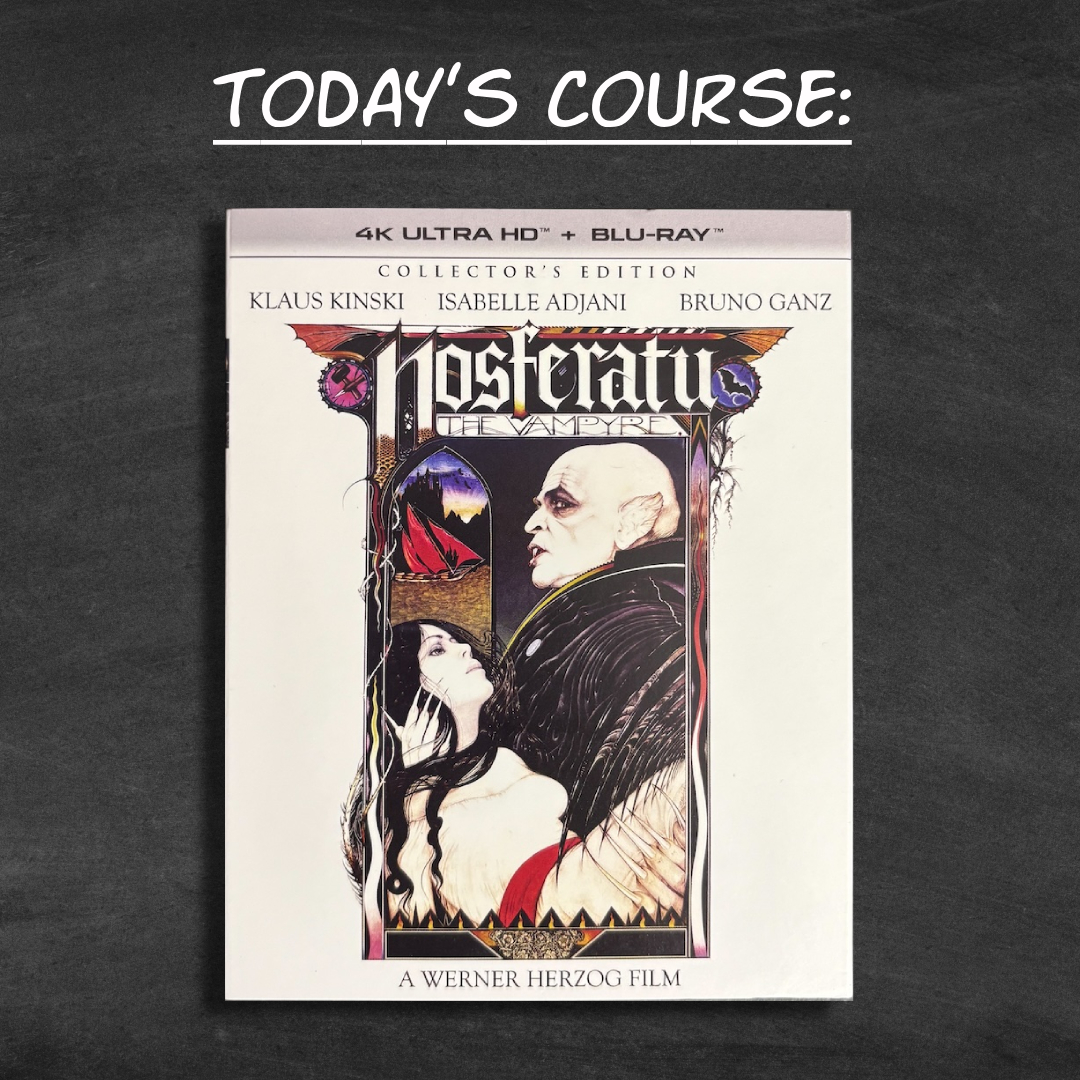
The film was given the 4K treatment from both the British Film Institute across the pond, and Shout/Scream Factory here in America. There was a bit of controversy upon the BFI release, with many people suspecting that AI was utilized in the source of their upgrade. Shout/Scream’s release arrived after, and after doing a side-by-side comparison, takes the cake in terms of quality. The transfer maintains Herzog and Schmidt-Reitwein’s aesthetic, retaining a good amount of grain, while massively upgrading its visual quality. The 4K release features both the English and German cuts of the film, plus two commentaries from Herzog; one in English and one in German. The Blu-ray Disc of the film also contains a vintage making-of featurette. The first run also included two posters that I had framed and hung on my wall. This is a must own for any fans of Herzog like me.
FINAL EVALUATION
Werner Herzog’s Nosferatu is a worthy successor to F.W. Murnau’s famed masterpiece, while also carving out its own identity. It’s clear that Herzog and his crew approached the film and story with respect for the source material; both Stoker’s and Murnau’s. It is a haunting vision that keeps you glued to the screen throughout. It’s like watching two trains on a collision course. You know what’s going to happen, and that it isn’t going to end well, yet you can’t look away. Herzog knows how to tap into that primal part of our brains as is evident here in Nosferatu. Top notch performances, a deliberate pace, and stunning visuals makes this a movie I return to each and every October.



Leave a Reply